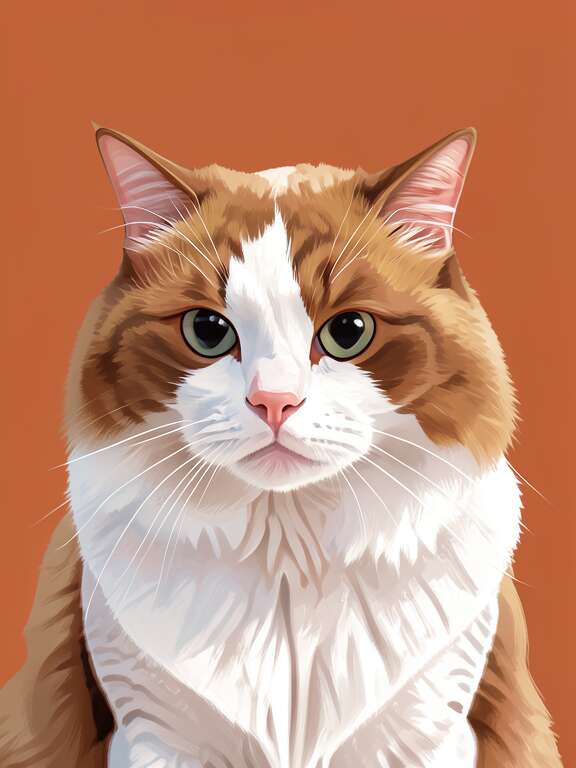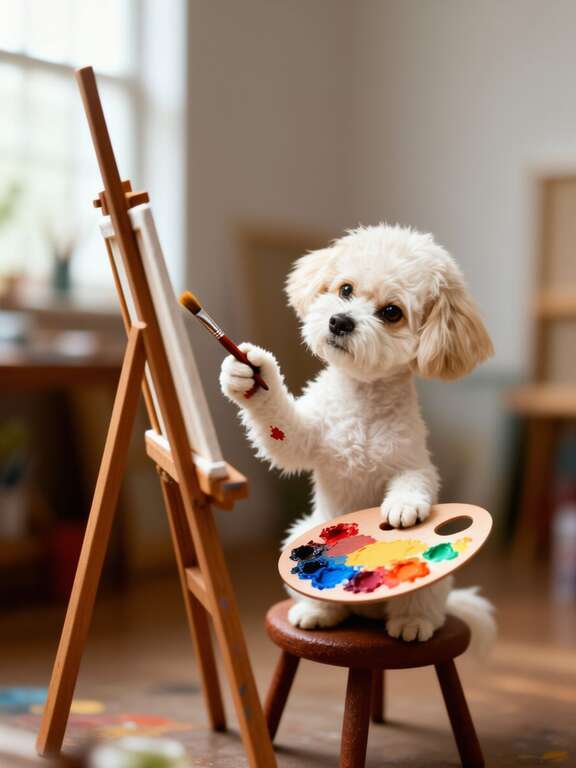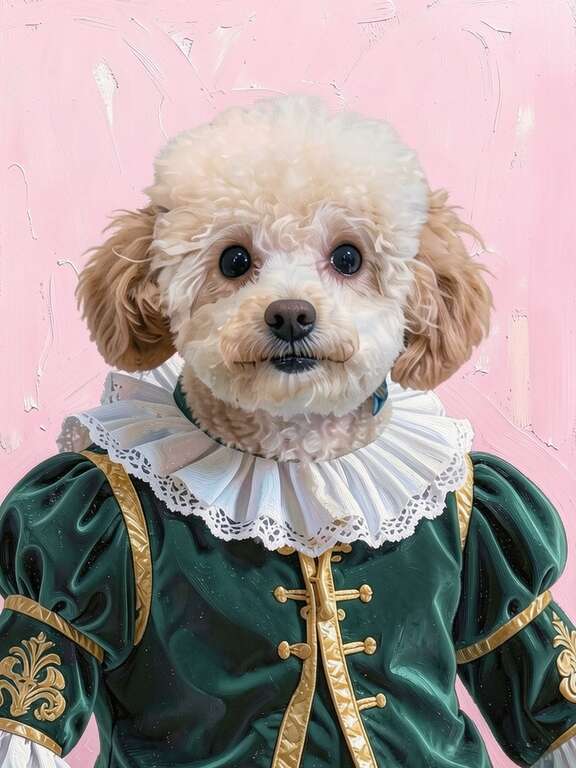
The short answer: Match size to placement using the 50-75% rule (portrait fills 50-75% of the furniture width below). Desk/nightstand: 5x7 to 8x10. Hallway/bathroom: 8x10 to 11x14. Above queen bed: 20x24 to 24x30. Above sofa: 24x30 single or 50-63 inch gallery. Above fireplace: 24x30 minimum, 30x40 for large mantels. Quick rule: whatever size you're considering, go one size up — almost everyone regrets ordering too small.
The most common pet portrait regret is ordering too small. An 8x10 looks great on a screen but disappears on the wall above a sofa. This guide gives exact sizing recommendations based on placement: above a sofa, above a bed, above a fireplace, on a desk, in a hallway, or as part of a gallery wall. Covers the 50-75% proportion rule, all standard print sizes compared, how viewing distance affects detail visibility, DPI resolution limits for maximum print quality, and the paper cutout test for testing size before ordering.
- The 50-75% rule: portrait fills 50-75% of furniture width
- Most common mistake: ordering too small — go one size up
- PawFav 300 DPI files print sharp up to 24x30, viewing-distance sharp to 30x40
- Paper cutout test prevents 90% of sizing mistakes
You're about to order a pet portrait and the print service is asking what size you want. 8x10? 11x14? 16x20? 24x30? They all sound reasonable. But the difference on your wall is enormous, and once it's printed, you can't resize it.
Sizing is where most first-time portrait buyers get it wrong. And the mistake is almost always the same: ordering too small. Here's how to get it right the first time.
What Is the 50-75% Rule for Wall Art Sizing?
Answer: The 50-75% rule is an interior design principle: art (or a gallery arrangement) above furniture should fill 50 to 75 percent of the furniture's width. For an 84-inch sofa, that's 42 to 63 inches of art. A 16x20 portrait fills only 24% — too small. A 24x30 fills 36% — borderline. A gallery of three pieces totaling 52 inches fills 62% — perfectly proportioned. This rule applies to every wall-furniture pairing.
Interior designers use a simple rule for sizing art above furniture: the portrait (or arrangement) should fill 50 to 75 percent of the furniture's width.
That means if your sofa is 84 inches wide, the art above it should be 42 to 63 inches wide. A single 16x20 portrait on that wall fills only 24 percent of the sofa width. It looks like a postage stamp. A 24x30 fills 36 percent, still a bit small for a solo piece but workable. A gallery arrangement of three pieces totaling 52 inches fills 62 percent and looks intentional.
This rule applies to any furniture-art relationship: the portrait above a console table, above a bed headboard, above a desk, or flanking a fireplace mantel.
What Are the Standard Pet Portrait Print Sizes?
Answer: Seven standard sizes cover most pet portrait needs. 5x7 ($5-$10) for desks. 8x10 ($8-$20) for bathrooms and gallery support. 11x14 ($15-$30) for hallways and offices. 16x20 ($25-$50) for above a desk or loveseat. 20x24 ($35-$65) for above a sofa or bed. 24x30 ($45-$80) for fireplace and entryway statements. 30x40 ($60-$120) for large living rooms and grand entryways.
| Size (inches) | Feels Like | Best Placement | Approximate Cost |
|---|---|---|---|
| 5x7 | Small photo | Desk, nightstand, shelf display | $5 – $10 |
| 8x10 | Standard frame photo | Bathroom, small hallway, gallery wall supporting piece | $8 – $20 |
| 11x14 | Noticeable | Hallway, home office, gallery wall, above nightstand | $15 – $30 |
| 16x20 | Substantial | Above a desk, loveseat, gallery wall centerpiece | $25 – $50 |
| 20x24 | Statement | Above a sofa, above a bed, dining room | $35 – $65 |
| 24x30 | Large statement | Above a sofa, fireplace, entryway focal point | $45 – $80 |
| 30x40 | Gallery scale | Large living room, above sectional, grand entryway | $60 – $120 |
Costs shown for canvas prints from Walgreens, Amazon, and comparable services. Prices vary by retailer and promotions.
What Size Pet Portrait Should I Order for Each Room?
Answer: Match size to placement. Above a sofa: 20x24 minimum, 24x30 ideal, gallery of 3-5 pieces totaling 50-63 inches even better. Above a queen bed: 20x24 to 24x30. Above a king bed: 24x30 or gallery. Above a fireplace: 24x30 minimum, 30x40 for large mantels. Desk: 5x7 to 11x14. Hallway: 11x14 to 16x20. Bathroom: 8x10 to 11x14 with humidity-resistant frame.
🛋️ Above a Sofa
This is the most common placement and the one most people get wrong. A sofa is wide, typically 72 to 96 inches, and the wall above it demands art at a matching scale. A single portrait needs to be at least 20x24, ideally 24x30. A gallery arrangement of 3 to 5 pieces is even better because it fills more width naturally.
🛏️ Above a Bed
The headboard anchors the wall, and the portrait should complement it, not compete. For a queen bed (60 inches wide), a single 20x24 or 24x30 canvas works well centered above the headboard. For a king bed (76 inches wide), go larger or use a horizontal gallery arrangement.
🔥 Above a Fireplace
The fireplace is the natural focal point of the room, and art above it gets the most viewing attention. Go bold. A single 24x30 or larger canvas creates the dramatic effect this location deserves. The mantel provides a natural visual base.
💼 Desk or Home Office
Office portraits are viewed at close range (2 to 4 feet) so smaller sizes work. An 8x10 or 11x14 on a desk, or a 16x20 on the wall beside or above the monitor, adds personality without overwhelming the workspace.
🚪 Entryway or Hallway
Hallways are narrow, so medium sizes work well. The viewing distance is shorter (people walk past, not sit 10 feet away) so detail is more visible. An 11x14 or 16x20 suits most hallway walls. For a staircase gallery, use matching 8x10 or 11x14 pieces.
🛁 Bathroom
Bathrooms have limited wall space and high humidity. Keep sizes small (8x10 or 11x14), use moisture-resistant frames or canvas, and avoid placement directly above the shower or bath where steam concentrates.
How Does Viewing Distance Affect What Size Pet Portrait I Need?
Answer: Viewing distance determines how big the portrait needs to feel and how much detail matters. Close (2-4 feet): 5x7 to 11x14 — every detail visible. Medium (5-8 feet): 11x14 to 20x24 — good detail, minor imperfections disappear. Far (8-15 feet): 20x24 or larger — composition matters more than fine detail; smaller prints lose impact. Match size to typical viewing distance, not to what looks right on your phone screen.
| Viewing Distance | Typical Locations | Recommended Size | What Matters Most |
|---|---|---|---|
| 2-4 feet (close) | Desk, nightstand, bathroom | 5x7 to 11x14 | Fine detail, paper quality |
| 5-8 feet (medium) | Hallway, dining room, bedroom | 11x14 to 20x24 | Composition + reasonable detail |
| 8-15 feet (far) | Living room, above sofa | 20x24 or larger | Color impact, overall composition |
Close viewing (2-4 feet): Desks, nightstands, bathroom. Every detail is visible. Fine art paper prints with high resolution look best. Even small imperfections show. Smaller sizes are fine because the eye can explore the full portrait without moving.
Medium viewing (5-8 feet): Hallways, dining rooms, bedroom walls. Good detail is visible but minor imperfections disappear. This is the most common viewing distance for home art. 11x14 to 20x24 sizes perform well here.
Far viewing (8-15 feet): Living rooms, above sofas viewed from across the room. Overall composition and color impact matter more than fine detail. Larger sizes (20x24+) are necessary because smaller prints lose impact at this distance. Canvas texture is invisible at this range, so canvas vs paper is a matter of preference, not quality.
What DPI Do I Need to Print a Pet Portrait?
Answer: 300 DPI is the print quality standard — sharp at any viewing distance. PawFav delivers 300 DPI files. 150-200 DPI is acceptable for larger prints (24x30+) viewed at typical wall distance (5+ feet). Below 150 DPI causes noticeable softening, especially in fine details. The practical PawFav limit is 24x30 at full sharpness and up to 30x40 at viewing-distance sharpness.
DPI (dots per inch) determines how large you can print before quality degrades. Here's the practical breakdown:
300 DPI: Print quality standard. Looks sharp at any viewing distance, including close examination. This is what PawFav delivers and what you should aim for at sizes up to 20x24.
150 to 200 DPI: Acceptable for larger prints (24x30 and above) viewed at typical wall distance (5+ feet). Detail softening is imperceptible at normal viewing distance. Most people can't tell the difference from 300 DPI once the print is on the wall.
Below 150 DPI: Noticeable softening, especially in fine details like whiskers and fur texture. Avoid printing below 150 DPI unless the portrait style is intentionally soft (watercolor, abstract).
The practical limit for most PawFav portraits is about 24x30 at full sharpness, and up to 30x40 at viewing-distance sharpness. For most home display, this covers every size you'd realistically want.
How Do I Test a Pet Portrait Size Before Ordering?
Answer: The paper cutout test. Cut newspaper or kraft paper to your candidate print's exact dimensions (e.g., 24 by 30 inches). Tape it to the wall at correct hanging height (57-60 inches center, 6-12 inches above furniture). Step back to your normal viewing position. Too small? Cut larger. Too large? Smaller. Order the size that feels right in context. This 5-minute test prevents 90% of sizing mistakes and costs nothing.
Before ordering, cut a piece of newspaper or kraft paper to the exact print size you're considering. Tape it to the wall where the portrait will hang. Step back to your normal viewing position (the sofa, the bed, the desk chair). Does it feel right? Too small? Too large? Adjust the paper until the proportions feel natural, then order that size. This 5-minute test prevents the most common sizing mistake and costs nothing.
How Do I Size a Pet Portrait Gallery Wall?
Answer: Gallery walls use multiple pieces, so individual sizes can be smaller while the arrangement fills the wall properly. Four popular configurations: uniform grid (4× 11x14 in 2x2 = ~26x32), centered cluster (one 16x20 + four 8x10 = ~40x28), horizontal row (3× 11x14 = ~38 inches wide), salon style (mixed sizes = ~48x36). Match the total arrangement to the 50-75% rule, not each piece individually.
Gallery walls use multiple pieces, so individual sizes can be smaller while the overall arrangement fills the wall properly. The most popular configurations:
- Uniform grid: 4 matching 11x14 in a 2x2 grid = roughly 26x32 total with spacing. Good above a console table or desk.
- Centered cluster: One 16x20 center, four 8x10 supporting pieces = roughly 40x28 total. Good above a loveseat or small sofa.
- Horizontal row: 3 matching 11x14 in a line = roughly 38 inches wide with spacing. Good above a long console or in a hallway.
- Salon style: Mixed sizes (one 16x20, two 11x14, two 8x10) = roughly 48x36 total. Good above a full sofa.
For detailed gallery wall planning including layouts and spacing, see our complete gallery wall guide.
Why Do Most People Order Their Pet Portrait Too Small?
Answer: Two reasons. (1) Sizes look bigger on phone screens than on walls — an 8x10 fills your screen but is roughly notebook-paper sized in real life. (2) Larger canvases cost more, so people instinctively scale down. But a $25 canvas that's too small is $25 wasted, while a $45 canvas that fills the space properly is $45 well spent. Quick fix: whatever size you're thinking, go one size up.
It bears repeating because almost everyone makes this mistake the first time. On your phone screen, an 8x10 preview looks great. But 8x10 inches on a wall is roughly the size of a piece of notebook paper. Above a sofa, it's comically tiny. Above a fireplace, it disappears entirely.
The psychology behind the mistake: larger sizes cost more, so we instinctively lean smaller to save money. But a $25 canvas that looks too small is $25 wasted, while a $45 canvas that fills the space properly is $45 well spent. Per dollar of visual impact, bigger is almost always the better value.
The quick rule: Whatever size you're thinking, go one size up. If you were thinking 8x10, order 11x14. If you were thinking 16x20, order 20x24. You'll be glad you did.
"I ordered a 16x20 of my golden retriever for above our sofa. It looked fine in the cart. On the wall it looked like a postcard in a museum. I reordered at 24x30 and it was perfect. The size difference on screen is subtle. On the wall it's dramatic."
Frequently Asked Questions About Pet Portrait Sizing
What size pet portrait works best above a standard sofa?
For a standard 84-inch sofa, a single portrait should be 20x24 to 24x30, or a gallery arrangement totaling 50-63 inches wide. The portrait should fill 60-75% of the sofa's width. A 16x20 looks too small above a full sofa; a 24x30 is the safe single-piece choice; a gallery of 3-5 pieces is even better because it fills more width naturally.
How big can I print a PawFav portrait without losing quality?
PawFav delivers 300 DPI files suitable for printing up to 24x30 inches with excellent quality at any viewing distance. Printing larger may result in slight softening visible at close range, though at normal wall viewing distance (5+ feet) prints up to 30x40 remain visually sharp. For most home display, 16x20 or 20x24 is the sweet spot.
Is it better to order a single large portrait or a gallery wall of smaller ones?
Both work — pick based on the wall and your style. A single large portrait (24x30+) creates a clean focal point and works well above a fireplace, dining room, or as a statement piece. A gallery wall (3-5 smaller portraits) feels more curated and personal, fills wall width more flexibly, and lets you mix styles or pets. Above a sofa, galleries often look more polished than a single piece because they better match sofa width.
What size pet portrait should I order if I'm not sure where I'll hang it?
16x20 is the most versatile size — large enough to feel substantial but flexible enough to work in most rooms. It fits above a desk, in a hallway, above a loveseat, or as a gallery wall centerpiece. 16x20 is also the sweet spot for gift-giving when you don't know the recipient's home setup. Avoid 8x10 unless you're certain the placement is close-viewing (desk or bathroom).
Does canvas vs framed print affect the size I should order?
Slightly. Framed prints often need a mat (1.5-3 inches on each side), so the visible artwork is smaller than the listed frame size. A 16x20 framed print might show only an 11x14 image. Canvas prints show the full image at the listed size. If you're matching to specific dimensions and using a framed print, account for the mat by going one size larger.
What's the smallest size pet portrait that still looks good on a wall?
11x14 is generally the minimum for a wall-displayed pet portrait that holds visual weight. Below that (8x10, 5x7), portraits work better as desk accessories, shelf displays, or gallery wall supporting pieces rather than standalone wall art. The exception: 8x10 in a hallway with close viewing distance can work because the eye is right next to it.
How do I size a pet portrait for an asymmetric or non-standard wall?
Use paper cutouts. Standard sizing rules assume rectangular walls above standard furniture. For staircase walls, slanted ceilings, narrow alcoves, or unusual layouts, the 50-75% rule still applies but to the visible viewing area rather than full wall width. Cut paper to candidate sizes, tape them up, step back, and adjust. Trust your eye — paper testing is more reliable than rules in unusual spaces.
Can I order one portrait file and print it in multiple sizes?
Yes. PawFav delivers a single high-resolution file you can upload to multiple print services and order at different sizes. The same portrait file can become a 5x7 for your desk, a 16x20 for the hallway, and a 24x30 for above the sofa — all from one creation. The 300 DPI file scales correctly across all standard sizes up to 24x30 at full sharpness.
Measure, Test, Order
Now you have the numbers. Grab a tape measure, check the width of your furniture, multiply by 0.6 to 0.75, and you have your target portrait width. Cut a paper test, tape it up, confirm it looks right, and order with confidence.
Your pet's portrait will look incredible on the wall. The only question is: how big do you want that incredible to be?
Create at Any Size
PawFav portraits print beautifully from 5x7 to 30x40. Preview your pet, then order the size your wall deserves.
Try PawFav Free